| DXCC Entity | JA-JS Japan | JD1 Minamitorishima I. | |||
| JD1 Iwo Is., Ogasawara Is. | |||||
| Area 2-5, 7-0 | Area 6 | Area 1 | |||
|---|---|---|---|---|---|
| Mainland | Okinawa | Mainland | Ogasawara | ||
| Individuals | JA#AA-ZZ J[A,E-S]#AAA-XZZ |
JA6AA-ZZ J[A,E-Q]6AAA-XZZ JR6AAA-QQZ |
JR6AA-NZ JR6QUA-XZZ JS6AAA-XZZ |
JA1AA-ZZ J[A,E-S]1AAA-XZZ 7[K-N][1-4]AAA-XZZ |
JD1AAA-XZZ |
| Clubs | J[A,E-O,Q-S]#YAA-ZZZ | J[A,E-O]6YAA-ZZZ | J[R,S]6YAA-ZZZ | J[A,E-O,Q-S]1YAA-ZZZ | JD1YAA-ZZZ |
| Repeaters | JR#WA-WZ, VA-VZ JP#YAA-YZZ |
JR6WA-WZ, VA-VZ JP6YAA-YZZ |
JR6YA-YZ JQ6YAA-YZZ |
JR1WA-WZ, VA-VZ JP1YAA-YZZ | |
| Remote Controllers for Repeaters |
JP#ZAA-ZZZ | JP6ZAA-ZZZ | JQ6ZAA-ZZZ | JP1ZAA-ZZZ | |
| Foreigners (First Licensed 1985-1999) |
7J[2,3]AAA-CZZ 7J[4,5,7-0]AAA-BZZ |
7J6AAA-BZZ | 7J6CAA-CZZ | 7J1AAA-DZZ | |
| Foreigners' Clubs (First Licensed 1993-1999) |
7J#YAA-YMZ | 7J6YAA-YMZ | 7J6YNA-YQZ | 7J1YAA-YMZ | |
| Special Event Stations, and ARISS School Contact Stations |
8[J,N]#$, 8[J,N]#*$, 8[J,N]#**$, 8[J,N]#***$, 8[J,N]#****$
Exceptions: - Antarctica: 8J1RL - Satellite: 8J1JCS | ||||
| JARL Stations | JA#RL JA[2,3,5,7,9]YRL JH4YRL JH8ZRL JR0ZAX |
JA6RL JH6ZRL |
JR6RL | JA1RL JA1YRL JA1YAA | |
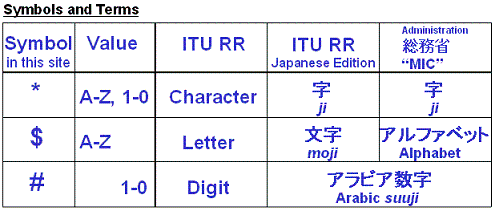
|
|
But the below will take you tons of exceptions!
Each Japanese amateur call sign has a two-letter prefix and two- or three-letter suffix, separated by a numeral(1-0) indicating the geographic region (1-0, Okinawa, Ogasawara). "Somusho," or "Ministry of Internal Affairs and Communications (MIC)" — the FCC equivalent — maintains Japan's call sign system in "Assignment Criteria of Identification Signals," in "Radio Law Related Screening Criteria," defined by MIC for their internal use as Instruction No. 67, Jan. 2001.
 |  |
| Radio Law Related Screening Criteria (Not Internet available but sold) |
Appendix 3 in it: Assignment Criteria of Identification Signals |
- Sequential Call Sign
Yes, but it is based on the station address — the transmit location — only.
It is not affected by either the mailing address or the licensee's operator class. - Vanity Call Sign
Never. - Special-Event Call Sign
Yes, but the licensee shall be not an indivitual but an organization. And the administrator directly issues the license — not by a coordinator. Any format call sign from 2×1 to 2×5 with an 8J or an 8N prefix is available — except a three-letter suffix QRA-QTZ. The last character shall be a letter (A-Z) according to ITU RR 19.68. - Special Prefix
Never, even though the JARL petitioned for this at the FIFA Worldcup 2002.
No Vanity Call Signs
Currently we cannot reserve any 'wished' call sign (vanity) for either an individual or a club station, although it had been allowed in some cases in the past (very early years).However, special call signs for special event stations are available on request. (e.g. 8J1HAM for the event station at Tokyo Ham Fair in our past.)
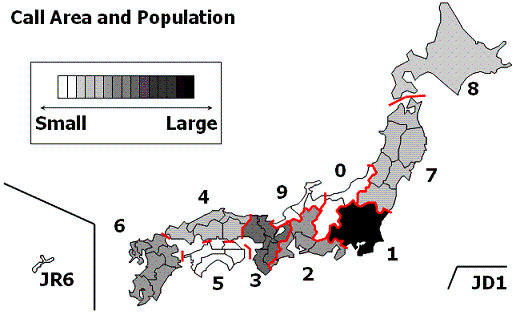
Call Areas and Populations
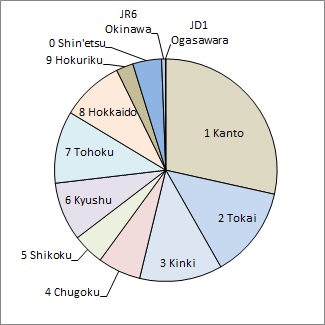
This tells you how easy to make contacts with some areas and how difficult to do with the others (e.g. Area 9). Area 1 is the most densely populated area. It is amazing nearly one third of people are there. The real number of amateur stations in each area is as follows:
 |
|
||||||||||||||||||||||||||||||||||||||||||||||||||||
Population and major cities are HERE for those interested.
Area Number Inversions
Call-area-number inversions rarely happened so far, and now, as follows.
| Call Sign | in Actual Area | Period | Reason |
|---|---|---|---|
| 8J1WJ | 2 | 1971 | Special-event station for The 13th Boy Scouts World Jamboree |
| 8J90XPO | 3 | 1990 | Special-event station for The International Garden and Greenery Expo |
| 8J2000 | 1 | 2000 | Specal-event stations for millennium celebration |
| 8N2000 | |||
| 8M2000 | |||
| JA0DTF | 2 | Since 2005 | Wishers to maintain his/her original "0" call sign after a call area border relocation, related to a merging of municipalities acrossing it (Other expired twelve call signs so far: JA0GQP, JG0SIB, JH0CBL, JH0JIA, JI0JFZ, JJ0EYM, JJ0GGQ, JJ0GGR, JJ0GGT, JJ0GIC, JJ0JXI, JR0SRS) |
| JA0QWO | |||
| JE0GEX | |||
| JE0JED | |||
| JF0VKE | |||
| JG0SIA | |||
| JJ0JXI | |||
| JR0CZK | |||
| 8N23WSJ | 4 | 2015 | Special-event station for The 23rd Boy Scouts World Jamboree |
Search example: JJ1WTL
Classes and Restrictions
Operational bands and limits of output power are as follows for each class.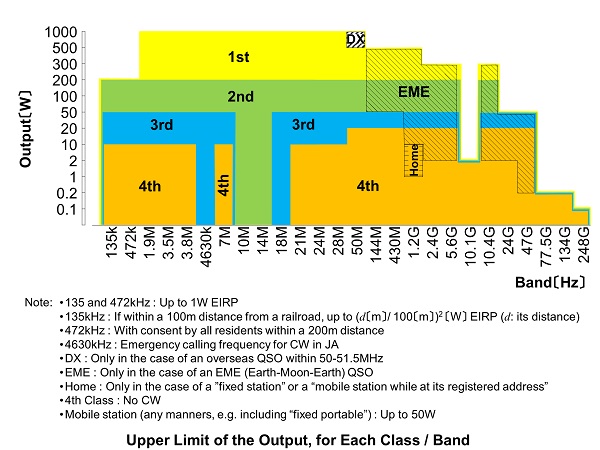
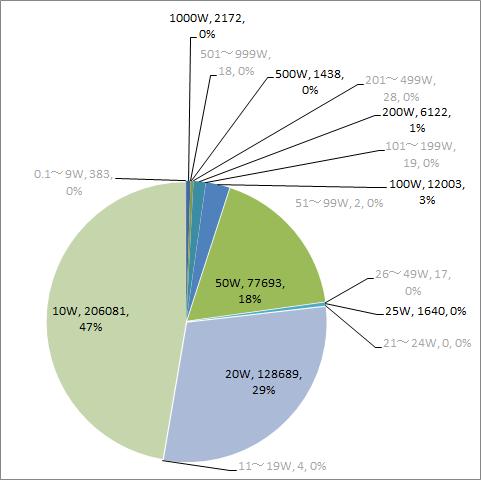
The ratio of licensed powers is as follows (as of Aug. 2, 2014).
| Class | 4th | 3rd | 2nd | 1st | ||||
|---|---|---|---|---|---|---|---|---|
| # of Licensees (as of Mar. 31, 2023; Counted Doubly, Triply or Quadruply among Four Classes) |
3,165,127 | 272,163 | 85,869 | 35,146 | ||||
| Maximum Output Power by the Ordinance (Details below) |
10W (21-30 and ≤8MHz) 20W (>30MHz) |
50W | 200W | No Limit | ||||
| Operational Bands by the Ordinance (Details below) |
21-30 and ≤8MHz >30MHz |
≥18MHz and ≤8MHz | No Limit | No Limit | ||||
| Mode | Phone / Digital | × | × | × | × | |||
| CW | × | × | × | |||||
| Band & Power | Fixed/Mobile \ Special Condition |
Fixed | Mobile (even Fixed Portable) |
Fixed | Mobile (even Fixed Portable) | |||
| 135k | 10W | 50W | 200W | 50W | 200W | 50W | ||
| Further Restriction Measured in EIRP | 1W (d[m]/100[m])2 W, within a 100m distance ‘d’ from a railroad | |||||||
| 472k | 10W | 50W | 200W | 50W | 200W | 50W | ||
| Further Restriction Measured in EIRP | 1W With consent by all residents within a 200m distance | |||||||
| 1.9M, 3.5M, 3.8M, 7M | 10W | 50W | 200W | 50W | 1,000W | 50W | ||
| 10M, 14M | 200W | 50W | 1,000W | 50W | ||||
| 18M | 50W | 200W | 50W | 1,000W | 50W | |||
| 21M, 24M, 28M | 10W | 50W | 200W | 50W | 1,000W | 50W | ||
| 50M | 20W | 50W | 200W | 50W | 500W | 50W | ||
| For Overseas QSO within 50-51.5MHz |
1,000W | |||||||
| 144M, 430M | 20W | 50W | 50W | 50W | 50W | 50W | ||
| EME | 200W | 500W | ||||||
| 1,200M | 10W | 10W | 10W | 10W | 10W | 10W | ||
| EME | 20W | 50W | 200W | 50W | 500W | 50W | ||
| Apart from the Station Address | 1W | 1W | (n/a) | 1W | (n/a) | 1W | ||
| 2,400M | 2W | 2W | 2W | 2W | 2W | 2W | ||
| EME | 20W | 50W | 200W | 50W | 300W | 50W | ||
| 5,600M | 2W | 2W | 2W | 2W | 2W | 2W | ||
| EME | 20W | 50W | 200W | 50W | 300W | 50W | ||
| 10.1G | 2W | 2W | 2W | 2W | ||||
| 10.4G | 2W | 2W | 2W | 2W | 2W | 2W | ||
| EME | 20W | 50W | 200W | 50W | 300W | 50W | ||
| 24G | 2W | 2W | 2W | 2W | 2W | 2W | ||
| EME | 20W | 50W | 50W | 50W | 50W | 50W | ||
| 47G | 0.2W | 0.2W | 0.2W | 0.2W | 0.2W | 0.2W | ||
| EME | 20W | 50W | 50W | 50W | 50W | 50W | ||
| 77G, 135G | 0.2W | 0.2W | 0.2W | 0.2W | ||||
| 249G | 0.1W | |||||||
Detail allocated bands in Japan are HERE for those interested.
i.e. We have
- about 3,000,000 operator licensees (lifetime-valid),
- 370,653 station licensees(1) (an additional application needed, 5-year-valid),
- 65,918(2) JARL members (¥7,200=$51(3) per year), exchanging total
- 9,655,753 incoming QSL/SWL cards per year(4), and
- 14,937 "CQ ham radio" magazine readers(5) (ordinary ¥900=$6.4(3), excluding comsumption tax, each month).
Where,
- (1)
- as of Mar. 31, 2023
- (2)
- as of Mar. 7, 2023;
including
53,089 regular members,
1,334 club-station members,
1,098 family members and
10,397 associate members (e.g. station-license-expired members and SWLs).- (3)
- USD 1 = JPY 140
- (4)
- FY2022 (Apr., 2022 - Mar., 2023);
including
7,957,182 for domestic,
1,113,265 for overseas and
585,306 for non-members (to be discarded after a three-month storing)- (5)
- Average, Jan. - June, 2018
Of course, the nomal upgrade path is 4th → 3rd → 2nd → 1st. (As you can imagine, in this case, he/she is counted as "four operator licensees" in the above table.) On the other hand, some professional radio licensees can establish a ham radio station without any of these four amateur classes.
| Eligible Professional Licensees | Considered as |
|---|---|
First-Class Radio Operator for General Services | | | * |-Second-Class Radio Operator for General Services | | | Amateur First-Class Radio Operator |
| | | |-Third-Class Radio Operator for General Services | | | | | | : # | Amateur Second-Class Radio Operator |
| |
| |-Aeronautical Radio Operator
| :
|
+-Maritime First-Class Radio Operator
  |
  +-Maritime Second-Class Radio Operator
    |
    | #
    | |
    |-Maritime Fourth-Class Radio Operator
    :

First-Class Technical Radio Operator for On-the-Ground Services
|
|   *
|   |
+-Second-Class Technical Radio Operator for On-the-Ground Services
  |
: | Amateur Fourth-Class Radio Operator |
Licenses
We have four classes: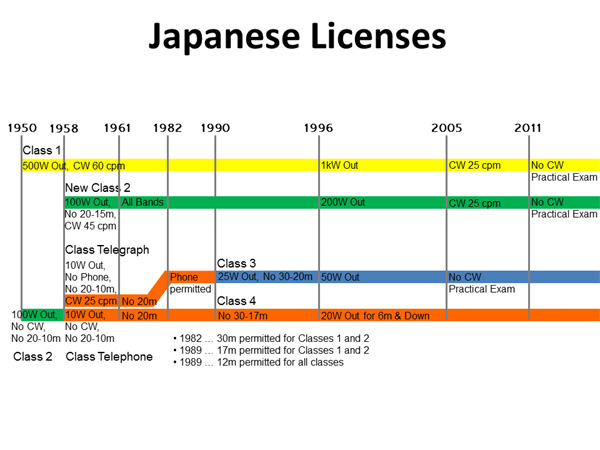
Code Test
The Morse code test was eliminated on Oct. 1, 2011 at last in JA too, after gradually having become easy:| Elements \ Effective on |
Japanese | English | (No Code) | |||||||
|---|---|---|---|---|---|---|---|---|---|---|
| TX | RX | TX | RX | TX | RX | TX | RX | |||
| June 30, 1950 (Radio Regulatory Commission Rules #6 of June 30, 1950) |
1st | (Old) 2nd | ||||||||
| 50 CPM for 5 min. | 60 CPM for 5 min. | No Code | ||||||||
| Nov. 5, 1958 (Ministerial Ordinance #28 of Nov. 5, 1958) |
1st | (New) 2nd | Telegraph | Telephone | ||||||
| ↓ | ↓ | 45 CPM for 5 min. | 25 CPM for 5 min. | No Code | ||||||
| Dec. 28, 1964 (Ministerial Ordinance #27 of Dec. 28, 1964) |
50 CPM for 3 min. | 60 CPM for 3 min. | 45 CPM for 2 min. | 25 CPM for 1 min. | ||||||
| Jan. 1, 1985 (Ministerial Ordinance #50 of Dec. 24, 1984) |
↓ | |||||||||
| Nov. 18, 1988 (Ministerial Ordinance #70 of Nov. 18, 1988) |
↓ | ↓ | ↓ | |||||||
| May 1, 1990 (Ministerial Ordinance #18 of Mar. 31, 1990) |
1st | (New) 2nd | 3rd | 4th | ||||||
| ↓ | ↓ | ↓ | 25 CPM for 2 min. | No Code | ||||||
| Apr. 1, 1996 (Ministerial Ordinance #75 of Oct. 6, 1995) |
||||||||||
| Oct. 1, 2005 (Ministerial Ordinance #95 of May 24, 2005) |
25 CPM for 2 min. | 25 CPM for 2 min. | (In the "regulation" test part*) | |||||||
| Oct. 1, 2011 (Ministerial Ordinance #48 of May 17, 2011) |
(In the "regulation" test part*) | (In the "regulation" test part*) | ||||||||
Where,
- CPM = Character per Minute.
1 WPM = 5 CPM in English, or
1 WPM = 4 CPM in Japanese (e.g. ‘mo’: — · · — ·).
- *: Examples (followed by four pickings):
(1) "How do you describe 7SENDAI using Morse code?"
(2) "If you want to stand-by immediately after your call, what brevity code should you transmit?"
All patterns of the call sign recycling in Japan are as follows:
| From | To | ||||
|---|---|---|---|---|---|
| With the Occupation Forces | |||||
| JA#$$ | Individuals/clubs in the Allied Occupation forces stationed in Japan,
issued 1949-52 (Changed to KA#$$) |
The Japanese after 1952 | |||
Example — JA3AA
| |||||
| Reuse after the Separation from Areas 1 and 2 to 0 and 9 Respectively | |||||
| JA1WA-ZZ | Individuals in current Area 0, issued 1952-54
(changed to JA0AA-DZ) |
Individuals in current Area 1 in 1958 | |||
| JA1WAA-WAF | Individuals in current Area 0, issued 1954-55
(changed to JA0EA-EF) |
Individuals in current Area 1 in 1965 | |||
| JA2WA-ZS | Individuals in current Area 9, issued 1952-54
(changed to JA9AA-DS) |
Individuals in current Area 2 1957-58 | |||
| For JARL | |||||
| JA[3,4,6]RL | Individuals | JARL District Stations | |||
| JA[7,0]IGY | Individuals | Beacons | |||
| JA1YAA | Communication Museum | JARL Museum in 1991 | |||
| JA[1,5,7]YRL | Clubs | JARL Support Stations | |||
| The Reuse | |||||
| J[A,E-S] [1,2,3,6] [AAA-QQZ,QUA-XZZ] |
Individuals | Individuals since 1985 in Area 1, 2, 3 and 6 | |||
Example — JE1AAT
|
|||||
| Failed Satellites | |||||
| JQ1YGU | Cube Sat "SEED" failed to launch in 2006 | Cube Sat "SEED" launched in 2008 | |||
| JQ1ZWS | Cube Sat "WASEDA-SAT2," no signals in 2008 | Cube Sat "WASEDA-SAT3," no signals again in 2017 | |||
| Irregular — Rare Cases | |||||
| JA1BF | Mr. Masunaga, JA1TV | Mr. Suzuki, JA1BFJ | |||
| JA1JG | Mr. Ooumi, JA1CET as his provisional license | Mr. Sakuma, JA3VO, for his use in Antarctica 1956-1958 as "Japanese Government" | |||
| JA1NZ | Mr. Oka | Mr. Ihara, JA1ADN | |||
| JA1BTT | Mrs. Kan, JA1YL | Mr. Ebina | |||
| JA1BWM | Mr. Sekiya | Mr. Watanabe | |||
| JJ1WUC | Mr. Kumagai, Son (SK) | Mr. Kumagai, Father, JM1RXM | |||
| JA3MX | Mr. Kitagawa, JA4GG es JA3AAC as his provisional license | Mr. Matsutani, JA3DAA | |||
| JA3NY | Mr. Yagi, JA3HW | Mrs. Yagi | |||
| JA3UB | Mr. Yoshitani, JA3IG | Mr. Nishikawa, JA3AVY | |||
| JA3BRG-BRL | Individuals in "Aviation & Aerospace Expo" for about seventy days in 1960 | Other Individuals in 1960 | |||
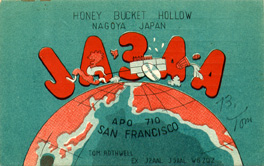
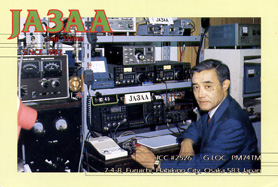
 issued in 1971
 issued in 1985
 issued in 2004