Currently, in Japan, no legal rules exist on a designator after/before a call sign, while the follows are our customs.
"/(call area)" — eg. JG1VGX/3
Some Japanese stations may use "(call sign)/(call area)" like JG1VGX/3. It's customary to append "/(call area)" based on JARL's recommendation. This may have two meanings.- Fixed Portable
In this case, the station is not portable or mobile in reality, but a home station having a commercial power source. - Moved
The holder used to live in Area 1 had now moved to Area 3, and he wants to keep the original Area 1 call sign rather than getting a new Area 3 call sign. - Staying at a boarding house, a weekend house, his/her parent's house, etc.
- Portable or Mobile
In this case, this Area 1 licensee is in Area 3, in his/her holiday or biz trip. He/She would be portable or mobile with batteries or a generator.
NOTE: ANY of the portable/mobile stations MUST run 50W or less output, even if the licensee has the 1st or the 2nd class. In addition, on 23cm, mobile/portable operation must be 1W or less. More limitations exist in SHF and upper.
"/(one's own call area)" — eg. JG1VGX/1
If someone uses "(call sign)/(one's own call area)", like JG1VGX/1, he/she is within his/her own call area but apart from his/her station address.Confusing fact about portable operations by 7K2-7N4 series licensees. e.g.
- 7L3BVB/1 — He/She is WITHIN his/her own call area (Area 1).
- 7L3BVB/3 — He/She is AWAY (in Area 3) from his/her own call area.
"/JR6"
Someone in a holiday in Okinawa use either- JG1VGX/JR6 (popular) ,
- JG1VGX/6 (for shorten) or
- JG1VGX/JS6 (rare, but strict...please remind that the first half of JR6 is not used in Okinawa).
"/JD1"
Likewise, "/JD1" is used usualy in Ogasawara, including Minami-torishima I.In Japan's call sign rule, there isn't any difference between two DXCC entities, which are sometimes written as JD1/O and JD1/M — "Ogasawara Is. (including Iwo Is.)" and "Minami-torishima I." respectively.
"JD1/"
Some operators append "JD1/" in advance of his/her own call sign in Ogasawara.| JD1/JA1AA | Apr. 17, 2007 |
| JD1/JA1BVA | Dec. 31, 2006 - Jan. 1, 2007 |
"/7J1" and "/7J"
In our past, "/7J1" and "/7J" were used in "JF1IST/7J1" (1979) and "JF1IST/7J" (1997, 1998), for Okino Torishima I. But now announced like "JQ1SYQ/JD1" (2001) even there.| Call Sign | Year | Remarks |
|---|---|---|
| KG61D | 1963 | Counted as Ogasawara Is. (Bonin and Volcano Is.) |
| 7J1RL | 1976 | Separated Entity |
| JF1IST/7J1 | 1979 | |
| JF1IST/7J | 1997 | Counted as Ogasawara Is. |
| JF1IST/7J | 1998 | |
| JQ1SYQ/JD1 | 2001 |
"/M" and "/CM"
Mobile in a car — some may use "/M" or "/CM" (but these two are unofficial even in our old day's rule), others may use "/(call area)." Mobile on bicycle, walking with hand-held — we tend to use "/(call area)" rather than "/M.""/MM"
This indicates Maritime Mobile (official, in our old rule)."/AM"
This indicates Aeronautical Mobile (official, in our old rule).The station operating output 5W or less may add "/QRP." Furthermore, "/QRPP" means 0.5W or less.
"/SO2005"
This is the first special designator in JA. To help commemorate "2005 Special Olympics World Winter Games Nagano Japan," pre-registered Hams are eligible to identify himself/herself by appending "/SO2005" to their call signs July 11, 2004 - Mar. 15, 2005.[Organizer: JARL Nagano Prefectural Branch]
"/60"
Some related amateurs to the "CQ Amateur Radio" are authorized to sign "/60," like JE1CKA/60,during the CQ Gang Award on-air party celebrating the 60th anniversary Jan. 1 - Mar. 1, 2005.[Organizer: CQ Amateur Radio]
"/OKA50" etc.
These are for the 50th anniversary of Japanese Amateurs in Okinawa. On June 22, 1961 — during the control of the United States — the first station by a Japanese in Okinawa, was on the air as KR8AB. These special designator is used in Okinawa, Jan. 1 - Dec. 31, 2011.[Organizer: JARL Okinawa Prefectural Branch]
- "/OKA50" ... Okinawahonto (AS-017)
- "/IEJ50" ... Iejima (AS-017)
- "/AGJ50" ... Agunijima (AS-017)
- "/KJP50" ... Kerama Is. (AS-017)
- "/UEO50" ... Kumejima (AS-017)
- "/MMY50" ... Miyakojima (AS-079)
- "/SHI50" ... Shimojishima (AS-079)
- "/TRA50" ... Taramajima (AS-079)
- "/ISG50" ... Ishigakijima (AS-024)
- "/OGN50" ... Yonagunijima (AS-024)
- "/HTR50" ... Haterumajima (AS-024)
- "/KTD50" ... Kitadaitojima (AS-047)
- "/MMD50" ... Minamidaitojima (AS-047)
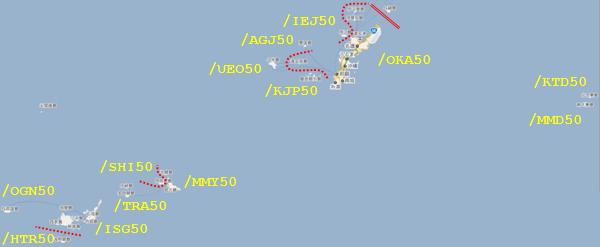
Each Location
- "/KM" ... Kumamoto Contest (Jan.)
- "/MG" ... All Miyagi Contest (Jan.)
- "/ME" ... All Mie 33 Contest (Jan.)
- "/MEJ" ... All Mie 33 Contest, Natives of Mie, outside Mie-pref. (Jan.)
- "/KT" ... Kyoto Contest (Feb.)
- "/GM" ... All Gumma Contest (May)
- "/NI" ... All Niigata Contest (May)
- "/KG" ... Kagoshima Contest (July)
- "/KJ" ... Kagoshima Contest, Natives of Kagoshima, outside Kagoshima-pref. (July)
- "/AT" ... All Akita Contest (Sept.)
"/RS"
"RS" stands for "Roadside Station (or Michi-no-eki)." We have about 800 Michinoekis all over Japan. Kuji Sunkist Club, JR7YKK issues "Michinoeki Awards" to hams who got a certain number of QSL cards, on which Michinoeki stamps put. I first heard this "/RS" designator in Sept., 2004."/JI#"
Island peditioners — especially for the following awards — sometimes append "/JI#" to emphasize that they are in their such duty.| Name | By | Terms | |||
| At least | Inhabited Is. | Uninhabited Is. | |||
| JIIA | Japanese IOTA Islands Award (Discontinued in 2009) |
JI6KVR (IOTA JA) | 10 islands | yes | yes |
| JDIA | Japan Desert Islands Award http://mujinto.jp/ |
Akitsu Island Freak, JR0ZDR | 10 islands | no | yes |
| JIA | Japan Island Award http://www.h5.dion.ne.jp/~matkee/award.htm |
JARL Tsushima Club, JA6ZDQ | 50 islands | yes | no |
This announcement first appeared on Feb 11, 2005 by JI3DST/JI3. The "I" in "JI" implies "Island." All examples extracted from "J-Cluster" and all JI3DST-blog's announcements are as follows. (There is no regulations prohibiting "/JI#" annoucement.)
| ID | ex-JIIA# | JDIA# | JIA# | Island | Prefecture | Date |
| JI3DST/JI1 | AS-008-011 | 10-104 | Shikine jima | Tokyo | July 27-30, 2012 Sept. 13-18, 2012 Oct. 19-22, 2012 July 26-30, 2013 |
|
| JA3YEC/JI1 | Sept. 13-18, 2012 Oct. 19-22, 2012 |
|||||
| 8J0SC50A/JI2 | AS-117*180 | 18-216 | — | Urui shima | Shizuoka | Aug. 16, 2009 |
| JI2ZLM/JI2 | AS-117-008 | 20-101 | Shino jima | Aichi | Jan. 3, 2006 | |
| AS-117*142 | 21-104 | Sakate jima | Mie | Dec. 24, 2005 | ||
| JF0BPT/JI2 | AS-117-049 | 21-102 | Toshi jima | Mie | May 6, 2007 | |
| AS-117*181 | 21-216 | — | O shima (Wagu o shima) | Mie | Aug. 8, 2008 | |
| AS-117*182 | 21-248 | — | Ko jima | Mie | Aug. 8, 2008 | |
| 21-224 | — | Ogura jima | Mie | Aug. 9, 2008 | ||
| JI3DST/JI3 | AS-117-085 | 26-101 | O shima (Kii o shima) | Wakayama | Feb. 11, 2005 July 29, 2006 July 29, 2007 |
|
| JS6RRR/JI3 | AS-117-085 | 26-101 | O shima (Kii o shima) | Wakayama | July 28, 2007 | |
| JF0BPT/JI3 | AS-117*172 | 27-106 | Numa shima | Hyogo | Oct. 25, 2007 | |
| JI3DST/JI4 | AS-117-096 | 33-112 | Kasado shima | Yamaguchi | Aug. 4, 2007 | |
| JA4PXE/JI4 | AS-117*147 | 33-248 | — | Kaeru shima | Yamaguchi | Mar. 19, 2006 |
| 33-265 | — | Kami kozu se | Yamaguchi | May 4, 2006 | ||
| JH4FRP/JI4 | AS-117*147 | 33-248 | — | Kaeru shima | Yamaguchi | Mar. 19, 2006 |
| 33-265 | — | Kami kozu se | Yamaguchi | May 4, 2006 | ||
| JH4WXV/JI4 | 33-265 | — | Kami kozu se | Yamaguchi | May 4, 2006 | |
| JS6RRR/JI4 | AS-117*136 | 31-106 | Kitagi shima | Okayama | May 20, 2007 | |
| JE7JIS/JI7 | AS-117*143 | 06-105 | Nono jima | Miyagi | May 17, 2008 | |
| JF0BPT/JI7 | AS-117-058 | 06-106 | Kesen o shima | Miyagi | Aug. 15, 2005 | |
| AS-117-053 | 06-108 | Eno shima | Miyagi | Aug. 17, 2005 | ||
| AS-117*138 | 06-109 | Izu shima | Miyagi | Aug. 17, 2005 |
"/P"
We never use "/P" for portable operation, whether fed by batteries or generators. We use "/(call area)" too, even in a such case."/Q"
A LID reportedly sent "/Q," in stead of "/QRP.""/JB" and "/JB8"
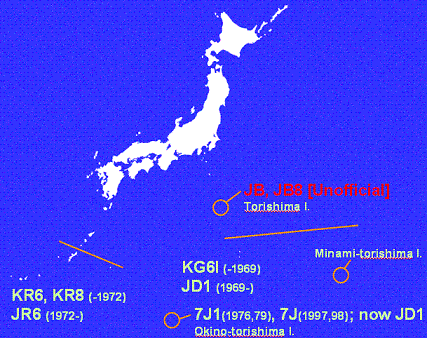
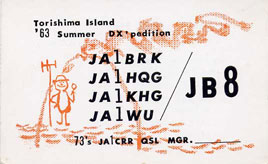
UNOFFICIAL made-up designators were used on Torishima I. in our past:
- JA7QQ/JB during his stay 1961-1962
- JA1BRK/JB8, JA1HQG/JB8, JA1KHG/JB8 and JA1WU/JB8 at "Torishima Island '63 Summer DX'pedition."
"JA#/(licensing country's call sign)" — eg. JA1/W1AW
NEVER, unfortunately (I'm sorry to say this).
He/She who wants to operate in Japan will have some ways.
| As a(n) → | Guest Operator | Club Station Member | Station Owner | Operator for a Special Event, Very Big | |||||
| Sharing Host's JA Spec Rig(s) | Buying Your Own JA Spec Rig(s) | ||||||||
| at an Individual Station | at a Club Station | Individual Station's | Club Station's | ||||||
| Nationality | Any | ||||||||
| Licenser | JA | Available | |||||||
| W,DL,VE,VK,F,HL,OH,EI,OA,ZL,YB,CEPT | |||||||||
| The Others | Not Permitted | Available | |||||||
| Form of Visitor's Station in JA | Individual | n/a | Available | Virtually Unavailable | Available | n/a | |||
| Club | Available | Not Permitted | |||||||
| Visitor's Paper Work | Nothing | Necessary | Nothing | ||||||
| Cost | Lisencing Fee | Nothing | Copies and Stamps for Eligibility Certificate (Pre-registration Required) | Necessary:
By Paper Submission: ¥4,300(≤200W) or ¥8,100(>200W); By Online Submission (but almost unable for a foreign visitor): ¥2,900(≤200W) or ¥5,500(>200W); In a case, 2 (or more) station licensees needed under 1 same call sign, typically, for a mobile station(≤50W) and each fixed one(>50W) |
Nothing | ||||
| Spectrum User Fee | n/a | ¥300/(station·year) | Nothing | ||||||
| Registration and License Tax | ≤500W | n/a | Nothing | n/a | |||||
| QROed from '≤500W' to '>500W' | Nothing | ||||||||
| Establishing a New '>500W' Station Initially | ¥30,000/station | ||||||||
| JARL Membership Fee (to Use QSL Bureau) | Admission | n/a | ¥1,000 | n/a | |||||
| Annual | ¥7,200 (Indivitual),
¥10,800 (Club) |
||||||||
| Rig(s) | Nothing | Necessary | Nothing | ||||||
| Others | Nothing | Club Membership Fee | Nothing | Ordinary Nothing; If Required, Several Handreds of Yen, for QSL Expense Burden |
|||||
| Call Sign | Whose | Host's | Host Club's | Club's | Your own one's Your Club's own one's |
Special-Event Staiton's | |||
| e.g. | JA1AAA (or JA1AAA/W1AW) |
JA1YAA (or JA1YAA/W1AW) |
JA1YAA (or JA1YAA OP W1AW) |
JA1AAA JA1YAA (or JA1YAA OP W1AW) |
8J2AI | ||||
| Address | Station | n/a (Host's) | n/a (Host Club's) | n/a (Club's) | Host's | n/a (Virtually Unavailable) | Anywhere, but of course inside JA | Special-Event Staiton's | |
| Mailing | Anywhere, but inside JA | Anywhere, but inside JA | n/a | ||||||
| Host's Presence as a Supervisor | W,DL,OH,EI Licensee | Execution of Additional Rights* | n/a | Mandatory, Any JA 1st/2nd Class Member (upto his/her operator license class restriction) | n/a | ||||
| Unexecution of Additional Rights | Mandatory | Mandatory, Any Club Member (i.e. 1st/2nd/3rd/4th class, upto his/her operator license class restriction) | n/a | ||||||
| The Others | n/a | ||||||||
| As a(n) → | Guest Operator | Club Station Member | Station Owner | Operator for a Special Event, Very Big | |||||
| Sharing Host's Rig(s) | Buying Your Own JA Spec Rig(s) | ||||||||
| at an Individual Station | at a Club Station | Individual Station's | Club Station's | ||||||
*: Summary of the Additional Rights — only available for W,DL,OH and EI licensees (any nationality) — are as follows:
| Licenser | Class | Unexecution | Execution, under the Control of | ||
| Assumed JA's Class | JA 2nd Class | JA 1st Class | |||
| W | Amateur Extra | 1st | 1kW | (n/a) | |
| Advanced | 2nd | 200W | (n/a) | 1kW | |
| General or Condition | 2nd | 200W | (n/a) | 1kW | |
| Technician,
licensed on Feb. 14, 1991 and before, or having Element 1A, 1B or 1C | 3rd | 50W | 200W | ||
| Technician | 4th | 10W or 20W (VHF and up) | (n/a) | ||
| Novice | 3rd | 50W | 200W | ||
| DL | A | 3rd | 50W | 50W loss | |
| B | 1st | 1kW | (n/a) | ||
| C | 4th | 10W or 20W (VHF and up) | 10W loss | ||
| OH | General | 2nd | 200W | (n/a) | 150Wcp (=300W AM?!) or 600Wp-p |
| Technician | 3rd | 50W | 150Wcp or 282Wp-p | 150Wcp (=300W AM?!) or 600Wp-p | |
| Novice | 4th | 10W or 20W (VHF and up) | 15Wcp or 60Wp-p | ||
| EI | A | 2nd | 200W | (n/a) | 399Wp-p SSB |
| B | 4th | 10W or 20W (VHF and up) | 150W input or 282Wp-p SSB | 150W input or 399Wp-p SSB | |
Please also refer to "Amateur Radio in Japan," in http://www.jarl.or.jp/English/0-2.htm.
The follows are the descriptions of "how to QRV in JA," according to this tree:
+- A. Japanese Speaker
|  |- a. National Exam
|  +- b. Lecture Course
|
+- B. Others
   |- a. Reciprocol Agreement -- any nationality but licensed by W, DL, VE, VK, F, HL, OH, EI, OA, ZL, YB or CEPT
   +- b. Others
      |- I. Expo Visitor
      +- II. Others -- sorry, you have no chance
|
- For Japanese speakers
If you can understand Japanese language very very well, you're eligible to get a JA operator license through either of the following ways, like native Japanese amateurs. Any nationality is acceptable.- A national exam
Held by Japan Radio Insutitute — an incorporated foundation — as follows:
Class Cost Repetition 4th ¥5,000 Every month or every quarter, depending on the venues 3rd ¥5,250 2nd ¥7,450 Three times per year 1st ¥8,950 - A lecture course
However, an end-of-course exam exists:-) And mainly only for lower classes at expensive cost. A course's contents and hours are defined by an ordinance of the Ministry of Internal Affairs and Communications (Musen Jujisha Kisoku, or Radio Operator Regulation) as follows:
Class Required Course Length (hour(s)) Remarks Radio Engineering
(minimum)Regulation
(minimum)End-of-course Exam 4th 4 6 1 Typically two full days course in weekends 3rd 6 10 1 Typically one full day 2+4 hours shorten course, for 4th class licensees' upgrade 2nd 35 27 2.5 Typically ten full day 29+17 hours shorten course, or alternatively, an "eLearning" course, both for 3rd class licensees' upgrade
Seven organizations provide such courses so far. Since 2009, the ministry permits for nongovernmental enterprises to hold them.
Class Cost Venue Tyipical Repetition (a) The Japan Amateur Radio Development Association (JARD) — a general incorporated foundation 4th ¥22,750 Nationwide e.g. in Tokyo, biweekly ¥7,750 Junior High-schooler and under 3rd ¥12,750 e.g. in Tokyo, monthly 2nd ¥49,750 eLearning Four times per year ¥19,750 Age 18 and younger ¥69,750 Coursework, Tokyo First held in November, 2015 ¥19,750 Age 18 and younger (b) Radio Shonen (or Radio Boy) — a specified non-profit juridical person 4th ¥16,750 Age 19 and older Sapporo etc. Monthly ¥2,750 Under Age 19 3rd ¥7,750 Age 19 and older Bimonthly ¥2,750 Under Age 19 (c) QCQ Kikaku (or QCQ Planning) — a stock company 4th ¥18,000 Tokyo etc. Every month ¥8,000 "Special" for middle school age and under Quarterly 3rd ¥9,800 Monthly (d) Kyoto Amateur Musen Shinkokai (or Kyoto Amateur Radio Promotion Group) 4th ¥36,000 Tanabe and Kyoto 2013 (e) Crystal-tech — a specified non-profit juridical person 4th ¥15,750 Age 20 and older Takarazuka Every month ¥10,500 Under Age 20 3rd ¥10,750 Age 20 and older Quarterly ¥7,750 Under Age 20 (f) Denki Rika Club (or Electricity and Science Club) 3rd ¥17,000 Parent Tokyo Summer, 2014 ¥11,750 Educator ¥11,750 High-schooler ¥5,350 Junior High-schooler and under (g) Kyoto Prefectural Union of Agricultural Co-operatives 3rd Kyoto Jan., 2015 (h) Radiotech — a stock company 4th ¥15,750 Age 20 and older Nara Mar., 2018 ¥10,750 Under Age 20 3rd ¥8,750 Age 20 and older Mar., 2018 ¥6,750 Under Age 20 In addition, graduates from the following three "Long Term Lecture Course Cirtified School (or Choki Gata Yosei Katei Nintei Ko)" can automatically get a radio operator license — which includes 4th Class Amateur Radio Operator's privilege — in conjunction with their guraduation.
School Course Class Term(s)
(Year(s))Miyagi Kesennuma Koyo High School Radio Polytechnic (for Graduates) 4th Class Maritime Radio Operator 2 Japan Coast Guard School Information System Course Aeronautical Radio Operator 2 Aeronautics Course 1 Japan Coast Guard Academy Cluster 3 (Information and Communication) 4
- A national exam
- Otherwise —
- Reciprocol Agreements
If you have a license of the eleve countries in the following table — but, nationality is ANY —, the reciprocol licensing agreement is available, according to Ministry of Posts and Telecommunications' Appended Table 1, Public Notice #326 of June 16, 1993.
Additional privilage in a club station
Especially, if you have a license of the following four countires, you may get some additional privilege in a club station, according to Ministry of Posts and Telecommunications' Appended Table 2, Public Notice #326 of June 16, 1993, under the control of a JA's 1st or 2nd class licensee.
e.g. If you're an American Advanced class licensee, you will be restricted up to 200W output regardless of your 1.5kW skills in the home country, under the basic reciprocol agreement which considers you as a Japanese 2nd class licensee equivalent.
However under the control of a JA's 1st class licensee in a 1kW — the Japanese legal limit — club station, you can QRO up to 1kW.
(But in this example, some restrictions still remain: only in the US Advanced class sub-bands even inside Japan.)
Anyway, if you want to become a member of a club station, without your own individual station licence in Japan yet, you have to get an "eligibility certificate" from the Bureau of the Ministry in advance, using a form of "Appended Table 3" in the public nortice, regardless of the execution/unexecution of the additional rights above.
Regulations for Foreigners' Operation in JA Licensed by Effective on Public Notice by
Ministry of Posts and Telecommunications (-2000) or
Ministry of Internal Affairs and Communications (2001-)Obsolete Obsolate Effective Club
Station
Operation
(Some
Privilege
Still
Remain)US Sept. 21, 1970 #816 of Sept. 21, 1970
revised by:
#345 of May 1, 1972;
#974 of Nov. 30, 1972;
#648 of Oct. 8, 1979;
#513 of Aug. 4, 1980;
#661 of Aug. 27, 1981;
#207 of Mar. 25, 1985;
#695 of Sept. 6, 1985;
#293 of Apr. 26, 1986;
#908 of Nov. 10, 1986;
#994 of Dec. 22, 1986
(effective on Dec. 28, 1986);
#81 of Feb. 18, 1987;
#347 of May 14, 1987#246 of Apr. 27, 1990
(effective on May 1, 1990)
revised by:
#480 of July 30 ,1992#326 of June 16, 1993
revised by:
#539 of Oct. 26, 1993;
#303 of July 1, 1998;
#24 of Jan. 11, 1999;
#831 of Dec. 25, 2000
(effective on Jan. 6, 2001);
#509 of Aug. 11, 2003
(effective on Jan. 13, 2004);
#269 of Mar. 29, 2004
#251 of June 29, 2011
(effective on June 30, 2011);
#255 of July 6, 2012
(effective on July 9, 2012);
#366 of Sept. 27, 2013
(effective on Sept. 29, 2013)
#397 of Oct. 21, 2013
#446 of Dec. 20, 2016
(effective on Dec. 21, 2016)
#147 of Apr. 21, 2020Germany Nov. 30, 1972 Finland Oct. 8, 1979 Ireland Aug. 27, 1981 Reciprocol
Operating
AgreementsUS Sept. 7, 1985 Germany May 1, 1986 Canada Nov. 16, 1986 Australia Feb. 25, 1987 France May 15, 1987 Republic of Korea Aug. 1, 1992 Finland June 16, 1993 Ireland June 16, 1993 Peru Aug. 1, 1998 New Zealand Sept. 29, 2013 Indonesia Oct. 21, 2013 CEPT Dec. 21, 2016 - Otherwise —
- For expo visitors
The Ministry SOMETIMES permits foreigner ham licensees issued by ANY country to operate a special-event station during a really BIG events. You can operate it in the scope of your home country license.
Foreigners Operable Special Event Stations — 8 Times So Far Call Sign Event Term Public Notice by
Ministry of Posts and Telecommunications (-2000) or
Ministry of Internal Affairs and Communications (2001-)8J1WJ Boy Scouts World Jamboree Aug. 2 - 10, 1971 #569 of Aug. 2, 1971 8J3ITU The 14th CCIR Kyoto General Meeting June 7 - 23, 1973 #377 of June 7, 1973 8N1WCY World Amateur Radio Conference (in World Communications Year) Sept. 19 - 25, 1983 #691 of Sept. 7, 1983 8J1XPO International Science and Technologies Expo in Tsukuba '85 Mar. 17 - Sept. 16, 1985 #175 of Mar. 15, 1985 8N1APT APT Amateur Radio Seminar June 10 - 17, 1994 #338 of June 10, 1994 8N3ITU The 14th ITU Plenipotentiary Conference in Kyoto Sept. 17 - Oct. 14, 1994 #473 of Sept. 5, 1994 8N0WOG Nagano Olympic Winter Game Jan. 24 - Feb. 22, 1998 #650 of Dec. 17, 1997 8J2AI The 2005 World Exposition, Aichi, Japan Mar. 25 - Sept. 25, 2005 #277 of Mar. 9, 2005 8N23WSJ Boy Scouts World Jamboree July 28 - Aug. 8, 2015 #166 of Apr. 14, 2015 - Otherwise — i.e. (1) no Japanese written exam, (2) without any licenses of the ten countries above and (3) not a very big expo visitor —, you have no chance.
But on the last occasion, if you are (1) an English speaker and have (2) a US mailing address, you can take an FCC exam even inside Japan. Some JA-based VE teams are working:
- ARRL/VEC Teams ... Michinoku (Sendai), Ibaraki, Tokyo, Yokohama, Nagoya and Kobe
- W5YI-VEC Teams ... Sapporo, Gumma (Maebashi) and Kyushu (Fukuoka)
- For expo visitors
- Reciprocol Agreements
As the result, an eligible person has three ways + one special way to operate and ID, in secluded Japan:
- Own Station
"(his/her own call sign in Japan)" — eg. JA1$$$
A foreigner who established his/her own individual station, contended with the obstacles.
He/She —
(a) has to prepare — in another word, "buy" — his/her own JAPANESE SPEC rig(s)∗ or,
(b) share a Japanese friend's eligible one(s)∗∗.
Where,- ∗:
Rig(s) which you broght from your home country — e.g. able to transmit on Japan's fire/amburance frequencies 146-148MHz — must not be permitted.
- ∗∗:
(i) His/Her station address must be same to the friend,
(ii) the friend must submit a "sharing agreement" to a District Bureau of Telecommunications, and
(iii) the rig(s) must match to your operating output power range (e.g. American Technician class licensee — Japanese 4th class equivalent — doesn't share Japanese 2nd class licensee's QRO rig(s)...Promise to attenuate during your operation?...Never permitted!).
- ∗:
- Club Member
"(club's call sign)/(operator's call sign)" — eg. JH1YDR/W3ACE
A foreigner who joined a club station as a member.
Member's call sign (or name) is omissible.
- Guest Operation
"(host's call sign)/(guest-operator's call sign)" — eg. JO3EIP/DJ3KR
A foreigner who is guest-operating a Japanese friend's station — both an individual s tation and a club station.
Guest operator's call sign (or name) is omissible. - Big Special Event
"(special-event station's call sign)" — eg. 8J2AI